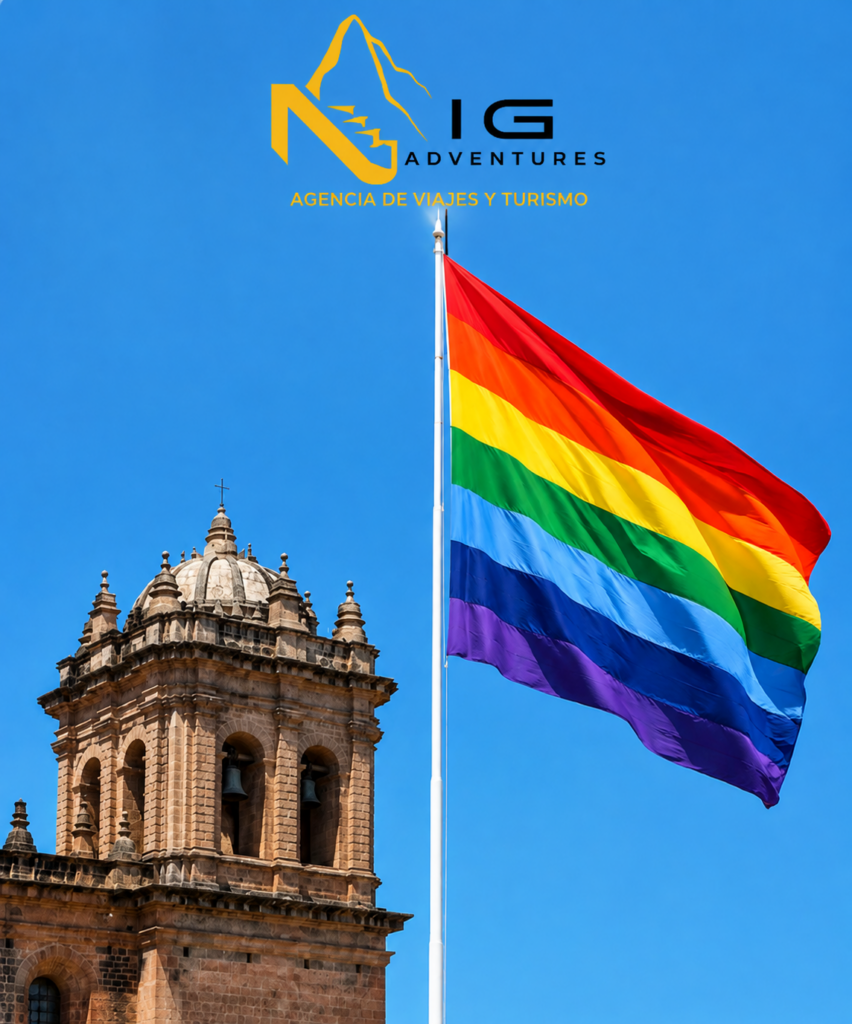
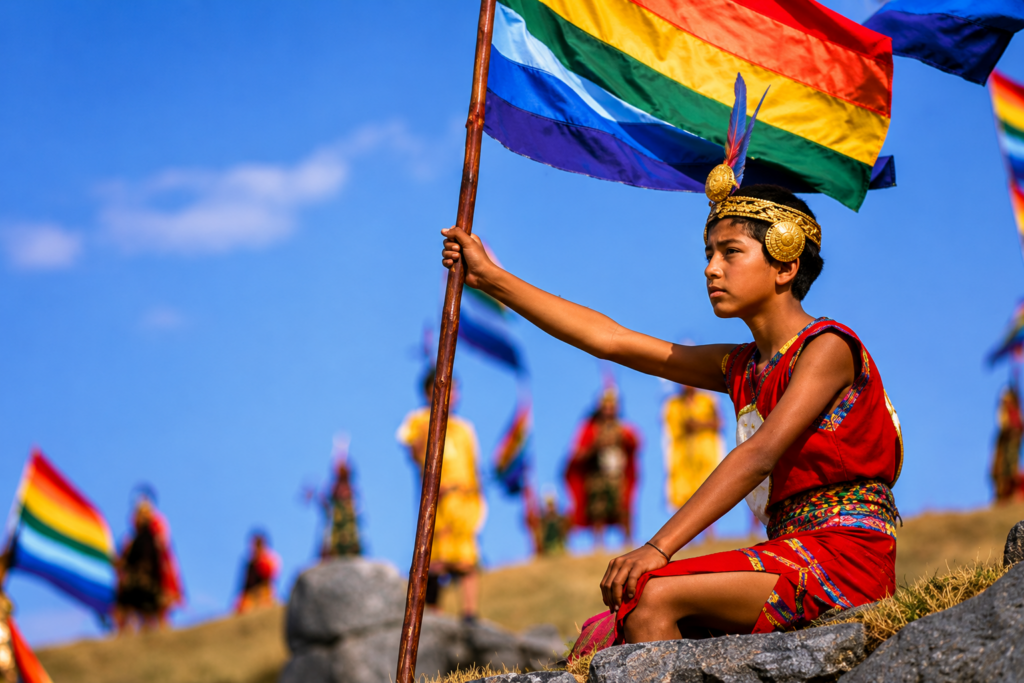
Many visitors to Cusco notice a seven-colored flag flying over public buildings, hotels, restaurants, and plazas. It is often referred to as the Flag of the Inca Empire or the Flag of the Tahuantinsuyo. However, this claim has long been debated by historians, as there is no historical evidence proving that the Incas used a national flag as we understand the concept today.
In this article, you’ll learn the true origin of the so-called Tahuantinsuyo Flag, its meaning, and why it has become one of the most recognizable symbols of Cusco.
What Is the So-Called Flag of the Tahuantinsuyo?
The so-called Tahuantinsuyo Flag consists of seven horizontal stripes in the following colors:
- Red
- Orange
- Yellow
- Green
- Light Blue
- Blue
- Purple
Today, it is one of the most visible symbols in Cusco and is commonly displayed during festivals, cultural events, and celebrations related to Andean identity.
Did the Inca Empire Really Have a Flag?
The short answer is no historical evidence exists.
The most important chroniclers of the colonial period, including:
- Pedro Cieza de León
- Garcilaso de la Vega
- Bernabé Cobo
- Pedro Sarmiento de Gamboa
provided detailed descriptions of the political, military, and religious organization of the Inca Empire. However, none of them mentioned the existence of a national flag similar to the one seen today.
Likewise, archaeologists have found no archaeological evidence indicating that the Inca Empire officially used a seven-colored flag.
For this reason, most historians agree that the so-called Flag of the Tahuantinsuyo is a modern cultural symbol inspired by Andean identity, rather than an authentic flag used during the Inca period.
Where Did the Seven-Colored Flag Come From?
The multicolored flag began gaining popularity in Cusco during the second half of the 20th century.
One of its main promoters was Radio Tawantinsuyo, a local radio station that adopted the design to represent the cultural diversity of the Andes. Over time, the flag became increasingly popular and eventually became closely associated with the identity of Cusco.
In 1978, the Provincial Municipality of Cusco officially recognized it as the city’s official symbol. That is why today it can be seen throughout public institutions, municipal buildings, and the city’s main squares.
It is important to note that this recognition applies only to the city of Cusco, not to the ancient Inca Empire.
What Does Each Color Represent?
Although there is no single official interpretation, the colors are traditionally associated with the following meanings:
🔴 Red
Represents the strength, courage, and heritage of the Andean peoples.
🟠 Orange
Symbolizes culture, creativity, and social organization.
🟡 Yellow
Represents energy, prosperity, and gold.
🟢 Green
Represents nature, agriculture, and fertility.
🔵 Light Blue
Symbolizes the sky and the universe.
🔷 Blue
Represents water, rivers, and lakes.
🟣 Purple
Represents spirituality and the Andean worldview.
These interpretations are modern cultural explanations rather than meanings documented during the Inca period.
Why Do Many People Call It the Flag of the Inca Empire?
Over the years, the seven-colored flag has become one of the strongest symbols of Cusco’s cultural identity.
International tourism has also contributed to the widespread belief that it was the official flag of the Incas. However, historians have found no historical evidence to support that claim.
Is the Cusco Flag the Same as the LGBTQ+ Pride Flag?
No.
Although both flags feature multiple colors, they are significantly different.
The Cusco Flag has:
- Seven horizontal stripes
- Both light blue and dark blue bands
The LGBTQ+ Pride Flag has a different color arrangement and represents an entirely different historical and cultural movement.
Where Can You See This Flag in Cusco?
During your visit, you’ll find the Cusco Flag in places such as:
- Plaza de Armas
- Provincial Municipality of Cusco
- El Sol Avenue
- Qorikancha
- Streets of the Historic Center
- Inti Raymi Festival
- Corpus Christi celebrations
- Various traditional festivals throughout the year
Interesting Facts
- It is one of the most photographed symbols in Cusco.
- Many souvenir shops sell flags, keychains, clothing, and decorative items featuring the design.
- Its popularity increased significantly during the late 20th century.
- Today, it primarily represents the cultural identity of the city of Cusco rather than the ancient Inca Empire.
Frequently Asked Questions
Did the Tahuantinsuyo Flag exist during the Inca Empire?
There is no historical or archaeological evidence confirming that the Incas used a seven-colored national flag.
Why is the flag displayed throughout Cusco?
Because the Provincial Municipality of Cusco officially adopted it as the city’s symbol in 1978.
Is it the official flag of the Inca Empire?
No.
It is a modern symbol associated with the cultural identity of Cusco and the Andes.
Is the flag related to the rainbow?
Yes.
Its multicolored design is often symbolically associated with the rainbow and the diversity of the Andes. However, this interpretation belongs to contemporary Andean culture, not to documented Inca history.
Final Thoughts
The so-called Flag of the Tahuantinsuyo is one of the most recognizable symbols of Cusco and modern Andean identity. However, historical research consistently concludes that there is no evidence proving that the Inca Empire used a seven-colored national flag.